


Sensing and Intuiting the Extraordinary Form of the Roman Rite
- Da Vasti Arts
- Apr 21, 2021
- 12 min read

Updated: May 17, 2021
21 April 2021 @ - PhST · Filipino & English

An artistic depiction of the Extraordinary Form of the Roman Rite offered by the Rev. Fr. Michell Joe Zerrudo during Corpus Christ 2020 per 1962 rubrics at the chapel of the Most Holy Redeemer Parish in Araneta using Autodesk Sketchbook on iPad 6th generation and Apple Pencil.
DISCLAIMER:
The insights entailed in this article are primarily based from the personal opinions, experiences, and knowledge of the vlogger. There is no intention of malice and insolence if there are statements which could be offencive or indiscreet to anybody (beforehand). Viewer discretion is advised, so take this video with a grain of salt.
Gratias tibi ago! Enjoy reading with the sarcasm!
(Terminology: the Extraordinary Form of the Roman Rite can be also called by several names like: Latin Mass, TLM, EF, Tridentine Mass, Vetus Ordo and/or Usus antiquor. This is the Tridentine mass promulgated by +St. Pius. PP. V., O.P. of 1570 during the Council of Trent, prior to the liturgical reforms of the 1960s-1970.
The latest edition of the TLM is based on the 1962 rubrics; but sometimes, pre-1955 practices are used with the need of grant of permission from Church superiors, esp. during Holy Week. The mass has since then been officially 're-permitted' under Ecclesia Dei by +St. John Paul II and promulgated under the motu propio Summorum Pontificum under Pope Emeritus Benedict XVI; who coined the term the Tridentine Mass as the 'Extraordinary Form' and the Novus Ordo as 'Ordinary Form'.)
A personal experience of the Latin Mass through the online experience...
Prior to my TLM experience
When I was young, I had no access of attending the Extraordinary Form of the Roman Rite, more notorious as the 'Latin Mass' or 'TLM (Traditional Latin Mass)'; growing up in a Novus Ordo of 1970 and beyond environment. During my younger years (somewhere between the periods of my 8-9 years of age and prior to my age of 17 at least), I surfed images and videos of the mass in Google; but I became suddenly appalled, since I have never seen an image of the priest facing ad orientem or ad apsidem; with unrivaled beauty and solemnity in a liturgy. Having this, I intuitively realised that we were deprived of inscrutable fittingness and authenticity (in experience) of having mass. Comparing to my masses in school, it seems like their masses are full of 'innovation' (supposed to be 'youth-enticing') which are unheard in terms of the fittingness and authenticity of the Roman Rite liturgy. This made me think up to the present that mass is not supposed to be a moment of modern entertainment; but rather a contemplative, reverent, and refreshing prayer, presentation, and sacrifice to God, like those in the Vatican or Rome (usually, but some places in Rome or Vatican are also full of 'crazy innovations' on a personal note). Personally, I absolutely abhorred the fact that we are forced to dance, sing, small talk, and SHOUT in mass like 'entertaining Protestants or non-denominational Christians' (which is even made more redundant during 'singing practice'). And if you do not participate or be audacious in activeness, it is like you are seen as a person who loathes/avoids a 'personal' relationship with God (consequently with absurd punishments like late recess or forced to be called like the teacher is in crazy stress; just stipulating my 'dark' and exaggerated humour).
Personally, I judge not the people who prefer this practice but if I will be followed, I wish to my superiors that there is TLM in school 🥺🙏🧎 (not angry just dramatically imploring a grant though like what UST did). If I may humbly ask, would you also please promulgate for students and LMPs access for the Tridentine Mass or 'Extraordinary Forms of Worship', akin to what you did on providing a charismatic worship event last foundation day celebrations prior to the pandemic?? You have to remember that there is no one way of worshipping the Trinity (cf. Eastern Rites for sarcastic purposes...maybe even try having some Eastern Rites also LOL); but it may potentially help some students to develop their faith again. Anyway, that is hardly possible, since I need to find a number of faithful who would like to have the same desire as me per Summorum Pontificum, and we traditionalists are a rarity.
Just back then, I was not aware of the conflict of traditionalists and liberal Catholics, and there was suppression or negative impression towards the TLM by those who are in the higher ecclesiastical ranks; just as Fr. Zerrudo once said in his last homily during Holy Shepherd Sunday 2021 in the TLM that they "mock traditionalists" (at least treat traditionalists with great contempt). Trads, ya know what I mean. If you don't know, better search on Google. This also seems the impression I see among some clergy, teachers, or lay people in our school, based on how the 'see' the liturgy should be. On one hand, I remember one teacher in our AP subject told us that back then (referring to the older batches or past years in school), it so happened she suggested and was put into effect that level masses within our Junior High School Department had "STAGE PLAY" in the Gospel. She thought that it should be a comeback, BUT SRSLY?!!, IT IS NOWHERE AND AGAINST THE RUBRICS OR PLAIN LITURGICAL ABUSE!!! On the other hand, one of my CL teachers taught that the Novus Ordo was put into place for the reasons of practicality and intelligibility (which makes the mass pragmatically flexible); which I do agree.
Prior to my TLM experience, I already had some background of Latin as self-taught. Thanks to the internet, DuoLingo (learing Romance languages and Latin which made my understanding of Latin better), constantly using Latinate terms in English, and Latin prayers, it helped me easily adjust to the TLM, even without the missal. Although I am not fluent enough to make a basic sentence & comprehend everything in the Mass, I still have the sense of intelligibility of interpreting oral and written Latin texts at a basic level.
COVID-19 pandemic opportunity (First time to participate)
Given the circumstances of the COVID-19 pandemic, it made us stay in our homes; which in turn gave me a perfect opportunity to worship the way my mind would love and my heart would know: attending TLM online. It is also a fact that our parish does not provide TLM and I heard from one priest that it is ridiculed by some superiors or staff, and another priest that there is a need of a motion to the one who calls the shots in our parish.
Churches, especially TLM societies, started livestreaming their masses; although this is not theologically sufficient for the true experience since there is a need to be physically present obligatory and moral reasons to objectively thank God in focus, and vis-a-vis reception of communion. For receiving the eucharist, transformed from the harvest of wheat and wine which died from their roots; like how Christ died for us to be sustained; as if salvation were nourishing food (making the sense that God is present to us and not doubting for Him doing His best just to appear to us for our desires).
The only caveat is that I am actually not supposed to do this to be an excellent conduct in our school because the criteria asks if "I attend the school online Masses/Liturgical celebrations" on our self-assessments. I inquired some clarity to my adviser about this and he told me that it is interpreted as "including attending the school-only online mass (when in strict quarantine) all the time, even if it is Sunday or not required"; which obstructs my freedom to contemplate and worship in the TLM. Ridiculous, right? But nevermind, LOL...
During my first experience of the TLM via the livestreaming by Ecclesia Dei Society of St. Joseph - Una Voce Philippines made me felt that it was worth it. It felt like the nature of the mass was deemed fit for me, having an INTJ-T personality (though MBTI types aren't credible per scientific experts, but still it gives some truth or accuracy, just not sharp enough). Though there were times I had to adjust like some propers or parts of the mass and the difference in liturgical calendar (Septuagesima, different feast days of Saints vs Novus Ordo, Last gospel, Leonine prayers, etc.); I was still able to adjust, since it suits my preferences and given my Latin background.
As an introvert, you how easily I am always overwhelmed in terms of today's society, given our predominately extroverted social environment of interaction and uproar. With that, the TLM is an antidote suites me better. Such liturgy in itself is like a time for me for a break from the noisy, buzzling, and stressful secular to the mystical, meditative world, which I see usually different from the mainstream one...like truly entering to the kingdom of God ignoring the stress outside, pay better attention than the mainstream mass, have some peace and just be instinctively amazed with the sense of the sacred.
With the Latin, it gives connection to the true expression of the Church of Peter theologically and intellectually. Plus it stays true to its original interpretation, unlike when it is vernacular. You can also attend mass literally everywhere in the world because it uses a constant, universal form of communication (connecting us closer to the CHURCH) and worship demeanour of beauty and sophistication; to the point I attended livestreamed TLMs as far as Toledo, Spain (Iglesia del Salvador de Toledo); Perth, Australia (St. Anne's TLM); and Chicago, USA (St. John Cantius), which basically makes it universally accessible, versatile, and adjust or can be attended by literally anybody.
Gaining Friends within the TLM community
Since then, given the power of social media and especially Facebook, I was able to find and reconnect people who has the same interest as I do within my school circle and community. I also checked their profiles and the pages they like typically related to the TLM like Ecclesia Dei Society of St. Joseph - Una Voce Philippines and Liturgical Arts Journal. One of them was my far-away relative, which my I and family funnily thought that I inherited such liking from her...LMAO. I also had a cousin who had the same interest; but he was lucky since he has attended it in person (though TBH he seems a bit radical but like an internet geek of some sort... so no wonder why he is like that...but nvm, he is just crazy because he is still too young or 'immature'). The other was my former guidance counselor, who also posts traditionalist things too and I also chat regarding things related to the EF liturgy. He was quite objective and open-minded to the point we even chat about political or sarcastic stuff.
But, the most surprising friend I gained on FB was one of priests who also celebrate TLM was none other than the Rev. Fr. Robert Paul Arias ‘Bob’ Zarate, SDB- an affiliate priest of Ecclesia Dei Society of St. Joseph (#sedsiuvPH). Realizing he was a Salesian himself (being a Bosconian), I persevered my best to one-on-one communicate with him. From my impression, he seems very welcoming to see some random Bosconian youth with great interest in the TLM. In spite of the joyful aspects, he constantly reminds the sad facts of the political aspects in the implementing the mass by the higher clergy, and the higher clergy being hostile towards traditionalists practice the faith. Nonetheless, he had an intuitive intelligence and sense of being very open-minded in things to expound or explain things I don't understand, generally.
Synthesising, with the my TLM relationship, I am hopeful that it would grow someday as relationships are blooming...
Theological and Liturgical depths of the TLM (from experience)
I noticed that compared to the Novus Ordo (esp. when looking through between missals), the TLM, or at least something like Dominican Rite missals contain this theological depth, reason, concept, doctrine, and argument ; which expresses the truth and epistemology of the faith in a very reasonable, elaborate, and rich context (with many symbology) of Apostolic tradition for thousands of years. Personally sensing, such depth is very intellectual but intelligible to people res ipsa loquitur akin to the Eastern Rites. To see what I am saying, kindly refer here:
Monday, June 04, 2018
The Byzantine Liturgy, the Traditional Latin Mass, and the Novus Ordo — Two Brothers and a Stranger PETER KWASNIEWSKI

Image source: New Liturgical Movement
Sadly, such golden wealth in the Latin liturgy suddenly faded, especially on the contemplative and intellectual aspect, like a door closing because it does not want some gold to show up for its light that the faithful forgot the truth, awareness, and sense of beauty in their mental happiness and satisfaction. It is like I'm kind of saying that there is sadly still kind of incompleteness in the Novus Ordo, which vanished some important aspects thereof.
Adding to that, there are expressions in the Extraordinary Liturgy, which by instinct is foreseen that it was inspired from my patron saint, St. Thomas Aquinas. The fact that (remember) the Summa Theologica was one of the basis of the Tridentine Mass during the Council of Trent, which seems quite instinctively apparent of its nature or 'persona'.
Such parts in the TLM strictly express incessantly, which are RARELY said in the Novus Ordo (cf. Eucharistic Prayer 1; since there ARE DIFFERENT EUCHARISTIC PRAYERS, with the shorest yet kind of theologically and epistemologically lacking but commonly used Eucharistic Prayer 2 imho ), like:
Quam oblatiónem tu, Deus, in ómnibus, quǽsumus, bene ✠ díctam, adscríp ✠ tam, ra ✠ tam, rationábilem, acceptabilémque fácere dignéris: ut nobis Cor ✠ pus, et San ✠ guis fiat dilectíssimi Fílii tui, Dómini nostri Iesu Christi.
TRANSLATION: Which oblation do Thou, O God, vouchsafe in all respects, to bless, ✠ approve, ✠ ratify, ✠ make worthy, REASONABLE, and acceptable; that it may be made for us the Body ✠ and Blood ✠ of Thy most beloved Son Jesus Christ our Lord.
Supra quæ propítio ac seréno vultu respícere dignéris: et accépta habére, sicúti accépta habére dignátus es múnera púeri tui iusti Abel, et sacrifícium Patriárchæ nostri Abrahæ: et quod tibi óbtulit summus sacérdos tuus Melchísedech, sanctum sacrifícium, immaculátam hóstiam.
TRANSLATION: Upon which vouchsafe to look with a propitious and serene countenance, and to accept them, as Thou wert graciously pleased to accept the gifts of Thy just servant Abel, and the sacrifice of our patriarch Abraham, and that which Thy high priest Melchisedech offered to Thee, a holy Sacrifice, and unspotted Victim.
Quod ore súmpsimus, Dómine, pura mente capiámus: et de múnere temporáli fiat nobis remédium sempitérnum. Corpus tuum, Dómine, quod sumpsi, et Sanguis, quem potávi, adhǽreat viscéribus meis: et præsta; ut in me non remáneat scélerum mácula, quem pura et sancta refecérunt sacraménta: Qui vivis et regnas in sǽcula sæculórum. Amen.
TRANSLATION: Grant, O Lord, that what we have taken with our mouth, we may receive with a pure mind; and from a temporal gift may it become to us an eternal remedy. May Thy Body, O Lord, which I have received, and Thy Blood which I have drunk, cleave to my bowels; and grant that no stain of sin may remain in me, who have been fed with this pure and holy Sacrament; Who livest and reignest for ever and ever. Amen.
Honestly, the last quote above made me think that this is the first time it opened my mind about the concept/connection of Manna in both the Old Testament and the New Testament, the reason of Christ and his eucharist that He is of validity from prophets and patriarchs of the Old covenant...
NO WONDER WHY PEOPLE DOUBT THE LOGIC/DEPTH OF THE FAITH OR THE REAL PRESENCE/TRANSUBSTANTIATION (HISTORICALLY AND THEOLOGICALLY)...
Trad conflicts
Despite the beauty of the TLM, it created some trade offs for me. For instance, it indirectly caused people in my family not being fully together (every time) at mass due to inherent reasons; but still one in happiness, love, and compassion to one another. To further expound, kindly refer to this video:
Furthermore, there was a recent incident (known to traditionalists residing in the Philippines), wherein an issue popped out. It was an event wherein some CSsR (Redemptorist) priest publicly attacked the TLM and mocked traditionalists. Soon enough, it was swarmed by different reactions and dissents, both by those hostile to TLM and the other spectrum. After, Fr. Jojo Zerrudo then expressed his indignation (known for its 'fiery Balintawak character') against the alleged 'arrogance' created by the aforementioned priest; especially during his last homily during Good Shepherd Sunday in the EF.
For further information, here are some of the posts regarding the issue:
The 'controversial' posts made by CSsR priest vs Trads:
The humble response made by the humble and professional Pastor Hope Jordan Guerrero:
The homily made by the Rev. Fr. Jojo Zerrudo as a response from the posts made by the CSsR priest. Start playing from 43:15-1:04:35 :
Also, regarding the conflict between liberal vs conservative Catholics, esp. in terms of worship, here is my humble opinion:
If we give space to the Charismatic Renewal, there then should also be a fair treatment to traditionalists who feel that the TLM helps strengthen their faith; because we must respect diversity and charismas that contribute to the promulgation and survival of the faith. But to note, it is ok for the Charismatic Renewal to practice their worship as long as they adhere to the General Rubrics of the Roman Missal and other Ecclesiastical teachings; which should also apply to us traditionalists, because obedience is moral and helps the grit of our faith to be stronger by being loyal to Rome and to ourselves (plus seditious actions just lead to a waste of money, time, and other important things we need). Let us accept the fact that both sides also did wrong things like several liturgical abuses and theological audacity amongst some charismatics; while sedition (like SSPX, SSPV, etc.) and hostility/extremism (narrow-mindedness) amongst some traditionalists. Every action has its place, just as Cardinal Arinze said (cf. https://www.youtube.com/watch?v=9rJFdmmqj_s) .
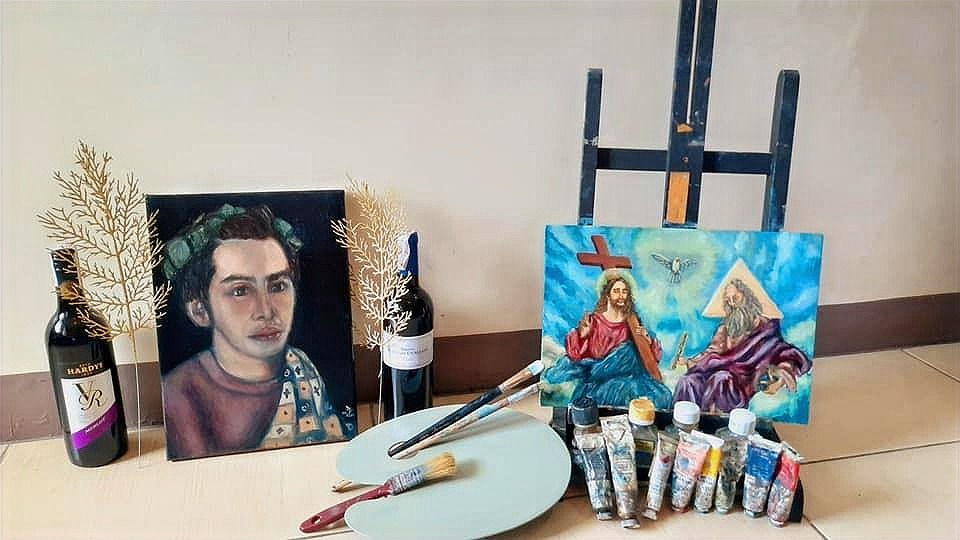
The Work as a Gratitude to the Rev. Fr. Jojo Zerrudo, @SEDSI.UVPH, CUSToS pro MiTra, & probably the TLM community
As the drawing depicts, this was made to thank as a “sign of gratitude to Fr. Zerrudo and #sedsiuvPH for the experience of #thesenseofthesacred”. The reasons for my sincere gratitude and the creation of the artwork are within this blog as aforementioned/beforehand.
For further details, refer to:
I presented this to the society in persistence and was commended as "Wonderfully done!" by them!
I then thanked them for their acceptance and tagged them on my instagram @sdsymar_1683.
Sources:
Ecclesia Dei PH: https://www.facebook.com/SEDSI.UVPH
Summorum Pontificum: http://www.vatican.va/content/benedict-xvi/en/motu_proprio/documents/hf_ben-xvi_motu-proprio_20070707_summorum-pontificum.html
Pre-55 liturgy: http://www.newliturgicalmovement.org/2021/04/ending-seventy-years-of-liturgical.html
Monday, November 09, 2020, The Four Qualities of Liturgy: Validity, Licitness, Fittingness, and Authenticity by PETER KWASNIEWSKI: http://www.newliturgicalmovement.org/2020/11/the-four-qualities-of-liturgy-validity.html
TLM general info: https://www.britannica.com/art/mass-music
Mullady, Brian (2006). "The Angelic Doctor – Thomas Aquinas". Archived from the original on 7 October 2008. Retrieved 6 May 2021. https://web.archive.org/web/20081007031948/http://www.holyspiritinteractive.net/columns/guests/brianmullady/thomasaquinas.asp


Comments